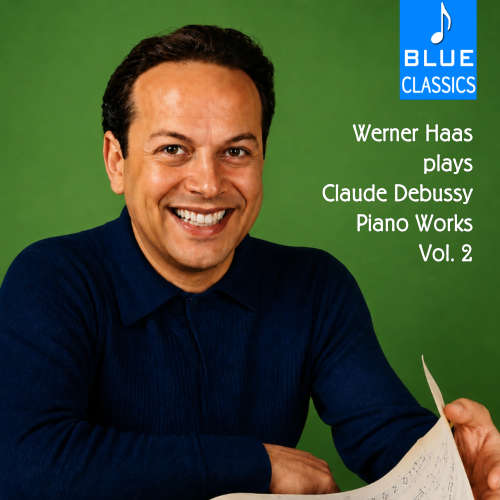
Title: WERNER HAAS PLAYS CLAUDE DEBUSSY PIANO WORKS VOL 2
Year: 1960
Category: CLASSICAL,PIANO,BLUECLASSICS
- 1. Douze Etudes: I. Pour les "cinq doigts"... 02:58
- 2. Douze Etudes: II. Pour les Tierces 03:11
- 3. Douze Etudes: III. Pour les Quartes 04:46
- 4. Douze Etudes: IV. Pour les Sixtes 03:35
- 5. Douze Etudes: V. Pour les Octaves 02:25
- 6. Douze Etudes: VI. Pour les huit doigts 01:30
- 7. Douze Etudes: VII. Pour les Degrés... 02:04
- 8. Douze Etudes: VIII. Pour les Agréments 04:23
- 9. Douze Etudes: IX. Pour les Notes... 03:15
- 10. Douze Etudes: X. Pour les Sonorités... 05:24
- 11. Douze Etudes: XI. Pour les Arpèges... 03:22
- 12. Douze Etudes: XII. Pour les Accords 04:53
- 13. Deux Arabesques: I. 03:52
- 14. Deux Arabesques: II. 02:54
- 15. La plus que lente 03:34
- 16. D'un cahier d'esquisses 04:46
- 17. L'Isle joyeuse 05:13
- Werner Haas - piano

WERNER HAAS PLAYS CLAUDE DEBUSSY PIANO WORKS VOL 2
by Werner Haas
The Études (CD 143) are the final collection for piano by Claude Debussy, comprising twelve pieces composed between 5 August and 29 September 1915. Divided into two books and dedicated to the memory of Frédéric Chopin, they were premiered partially by pianists George Copeland on 21 November 1916 in New York City; Walter Rummel on 14 December 1916, at a concert for the benefit of "L'Aide affectueuse aux musiciens" in Paris; and Marguerite Long on 10 November 1917 at the Société nationale de musique. Composed during the turmoil of World War I, this work is characteristic of Debussy's "late style" – austere, concentrated, and visionary.
The Two Arabesques (Deux arabesques), L. 66, is a pair of arabesques composed for piano when Debussy was still in his twenties, between the years 1888 and 1891. The arabesques contain hints of Debussy's developing musical style. The set is one of the very early impressionistic pieces of music, following the French visual art form. Debussy seems to wander through modes and keys, and achieves evocative scenes throughout both pieces.
La plus que lente, L. 121, ("The more than slow"), is a waltz for solo in 1910, shortly after his publication of the Préludes, Book I. The piece debuted at the New Carlton Hotel in Paris, where it was transcribed for strings and performed by the popular 'gipsy' violinist, Léoni, for whom Debussy wrote it (and who was given the manuscript by the composer).
L'isle joyeuse, L. 106 (The Joyful Island) is a piece for solo piano composed in 1904. It is assumed that the painting The Embarkation for Cythera by Jean-Antoine Watteau served as inspiration for the piece, with Debussy reimagining a group's journey to Cythera, the island considered Aphrodite's birthplace, and their subsequent ecstatic unions of love upon arrival.
Werner Haas (March 3, 1931 – October 11, 1976) was a German classical pianist. He was known for his performances of early 20th century compositions, particularly those of Claude Debussy and Maurice Ravel. He had a wide repertoire that also included works by Johann Sebastian Bach, Wolfgang Amadeus Mozart, Franz Schubert, Robert Schumann, Frédéric Chopin, Ludwig van Beethoven, Sergei Prokofiev, Dmitry Kabalevsky, and the complete works for piano and orchestra by Pyotr Ilyich Tchaikovsky. He was born in Stuttgart, Germany and attended the Stuttgart Academy of Music. Later he was a student of Walter Gieseking in his Saarbrücken master-classes. His recording of the complete works of Debussy was awarded the Grand Prix du Disque in 1962. Other recordings of Ravel by Haas were given the Amsterdam Edison Prize, in 1970.
Haas recorded the complete cycle of Debussy's solo piano works between 1959 and 1963. The works on this album were recorded in Paris between 1960 and 1961.
EU Public Domain Notice
The historical sound recordings on the Fontana label included in this release are in the public domain in the European Union. Blue Music Group has created a new digital restoration and mastering of these historical recordings. The digital restoration and mastering by Blue Music Group are protected by applicable copyright and related rights. Rights may differ in other territories, including the United States. This release is not intended for distribution in the United States.
Cover artwork: The original photographic image has been legally assessed as being in the public domain in the EU following the expiry of the applicable 50-year term under Section 49a. The image has been restored, enhanced and colorized by Blue Music Group. © Blue Music Group. All rights reserved.